

BMW Brake Pad Replacement in Abu Dhabi
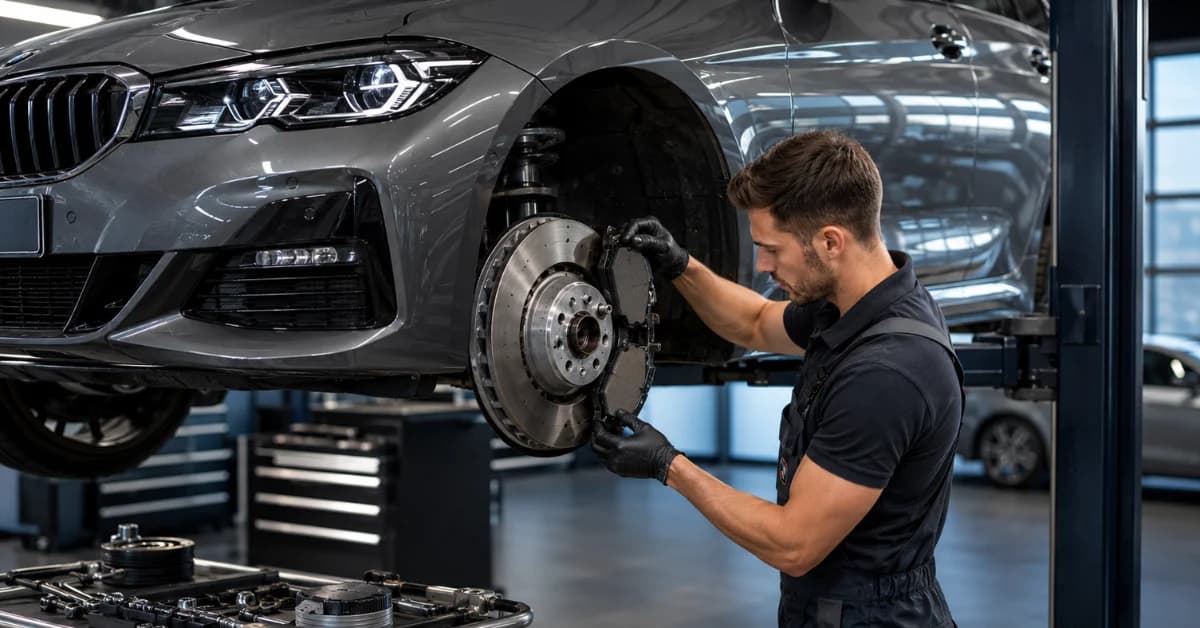
Exotic Auto Services delivers full-scope BMW brake services in Abu Dhabi, including pad replacement, rotor inspection, caliper overhaul, brake fluid flush, ABS diagnostics, and DSC system verification, performed by certified technicians using OEM-grade components and manufacturer-approved procedures.
- 10+ Years of Experience
- 100% Satisfied Clients
- 24/7 Pickup & Delivery Service
- 2x Quick Service
10,000+
Vehicles serviced
12
Service categories, one roof
12-Month
Warranty on parts & labour
25–40%
Below dealer pricing
Exotic Auto Services
Why Choose Exotic Auto Services for BMW Brake Service in Abu Dhabi?
Certified BMW Brake System Technicians
Technicians hold manufacturer-level certifications covering BMW braking architectures across the 1 Series, 3 Series, 5 Series, 7 Series, X3, X5, and M-series platforms. Rotor lateral runout is measured using a dial indicator, detecting deviations as low as 0.05 mm.
Genuine OEM Brake Parts & Specialist Equipment
Only OEM-approved brake pads, rotors, caliper assemblies, brake hoses, master cylinder units, brake fluid, and ABS wheel speed sensors are used. The workshop operates electronic brake bleeding machines, dial indicator runout gauges, BMW-specific ISTA diagnostic scan tools, and brake dynamometer verification equipment.
Efficient Brake Service Turnaround
A standard front or rear brake pad replacement is completed within 1 to 2 hours. Pad and rotor replacement on a single axle takes 2 to 3 hours. A complete four-wheel brake overhaul takes 4 to 6 hours, depending on the specific BMW model configuration.
Clear and Consistent Pricing
All brake service costs are confirmed before work begins. No additional charges are introduced once the repair starts. A written service report listing all replaced components, rotor thickness measurements, pad wear readings, and brake fluid test results is provided at vehicle handover.
What's included
BMW Brake Services We Provide
Brake System Diagnostic & ABS Fault Analysis
BMW ISTA scan tools retrieve active and stored DTCs. Road-test pressure analysis identifies whether brake fade, pull, or vibration originates from pad glazing, rotor thickness variation, caliper binding, or ABS sensor signal degradation before disassembly begins.
Brake Pad Inspection & Replacement
BMW OEM brake pads carry a minimum serviceable thickness of 2 mm. New pads are bedded in through a controlled 5-stop deceleration cycle from 50 km/h to confirm even contact patch distribution across the rotor face.
Brake Rotor Resurfacing & Replacement
Lateral runout above 0.08 mm and thickness variation above 0.015 mm produce pedal pulsation and steering vibration under braking. Rotors within tolerance are resurfaced on a brake lathe; rotors below minimum thickness or showing heat cracking are replaced with OEM-matched assemblies.
Brake Caliper Overhaul & Replacement
Caliper pistons are measured for bore clearance, with a maximum allowable clearance of 0.15 mm before replacement. Overhauled calipers receive new dust seals, guide pin boots, and OEM-spec brake grease at all sliding contact surfaces.
Brake Fluid Flush & Hydraulic System Service
BMW recommends brake fluid replacement at two-year intervals or when moisture content exceeds 3%. A pressure-bleed flush purges all four corners of the hydraulic circuit and refills with BMW-approved low-viscosity DOT 4 LV fluid.
ABS & DSC Sensor Inspection & Replacement
A sensor air gap outside the 0.2 to 1.5 mm specification causes erratic ABS activation or DSC warning illumination. Faulty sensors are replaced with OEM units, followed by a road-speed verification test to confirm signal accuracy.
Brake Master Cylinder Inspection & Replacement
A leaking primary or secondary piston seal produces a spongy pedal feel, a dropping fluid level, or reduced braking force. Internal bore wear beyond 0.10 mm requires full master cylinder replacement using an OEM assembly.
Brake Hose & Line Inspection
Rubber brake hoses degrade internally after 100,000 km, producing a ballooning effect. Hard steel brake lines are assessed for corrosion-induced wall thinning, with replacement required when wall thickness drops below 0.5 mm.
Handbrake & Electronic Parking Brake (EPB) Service
BMW models from the E90 generation onward use an EPB system requiring ISTA diagnostic software to retract caliper pistons during rear pad replacement. Incorrect retraction without software control damages the EPB motor and actuator assembly.
Brake Booster Inspection & Vacuum Test
The brake booster multiplies pedal force by a factor of 3 to 5 times. Vacuum supply is tested at the booster inlet, requiring a minimum of 500 mmHg, with a drop below 350 mmHg indicating a diaphragm leak.
Brake Pad Wear Sensor Replacement
Sensors are replaced as a complete axle set alongside new pads, and the fault code is cleared using ISTA after installation to confirm correct resistance values at both front and rear sensor circuits.
Ceramic & Performance Brake Upgrade Service
BMW M-series and performance variant owners benefit from carbon-ceramic brake discs and high-temperature pad upgrades. Ceramic compound pads rated above 900°C lower unsprung mass by up to 50% compared to cast iron rotors.
How it works
How to Book
Share Your BMW Details
Provide your BMW model, model year, current mileage, drive configuration, and a description of the braking symptom you have observed. This allows technicians to prepare the correct OEM brake components before your vehicle arrives at the workshop.
Make a Booking
Select a date and time that suits your schedule. Same-day and next-day appointments are available, and a free pickup and delivery service is offered across Abu Dhabi.
We Repair
Certified brake technicians carry out the complete brake service and provide a written inspection report at job completion. You receive status updates at each stage of the service.
25–40%
Below dealer pricing
12-Month
Warranty on parts & labour
10,000+
Vehicles serviced
Signs to watch for
When Does Your BMW Need Professional Brake Service?
| Issue | Symptoms / Signs | Possible Cause | Recommended Solution |
|---|---|---|---|
| Brake Warning Light | Amber or red brake indicator illuminated on the iDrive cluster; pad wear message displayed | Pad thickness below 2 mm; wear sensor circuit open; low brake fluid level | Pad wear sensor scan, pad thickness measurement, fluid level verification, and OEM pad replacement |
| Pedal Vibration Under Braking | The steering wheel or brake pedal pulsates during moderate to firm braking above 60 km/h | Rotor lateral runout above 0.08 mm; rotor thickness variation above 0.015 mm | Rotor runout measurement, brake lathe resurfacing, or OEM rotor replacement |
| Pulling to One Side | Vehicle drifts left or right under braking without steering input | Seized caliper piston; restricted brake hose, creating unequal caliper pressure | Caliper piston retraction test, hose fill-time check, caliper overhaul or replacement |
| Spongy or Soft Pedal | Pedal travels further than normal before braking force builds | Air in hydraulic circuit; deteriorated brake fluid above 3% moisture; master cylinder seal wear | Brake fluid moisture test, pressure-bleed flush, and master cylinder inspection |
| Grinding Noise During Braking | Metallic grinding or scraping noise at the wheel position during brake application | Pad friction material fully worn; pad backing plate contacting rotor surface | Immediate pad and rotor inspection; OEM pad and rotor replacement |
| Extended Stopping Distance | The vehicle requires greater pedal effort or a longer distance to reach a complete stop | Glazed brake pads from overheating; worn pad compound; contaminated rotor surface | Pad and rotor inspection, friction surface cleaning or replacement, and brake bedding procedure |
| ABS Warning Illuminated | ABS or DSC warning remains active; system reverts to non-ABS braking under emergency stops | Faulty wheel speed sensor; incorrect sensor air gap; ABS module communication fault | ISTA wheel speed sensor scan, sensor air gap measurement, and OEM sensor replacement |
| Brake Fluid Leak | Fluid traces visible near caliper, hose junction, or master cylinder | Deteriorated caliper piston seal; cracked brake hose; master cylinder primary seal failure | Hydraulic circuit pressure test, leak source identification, and component-specific seal or hose replacement |
Why it matters
Benefits of Professional BMW Brake Servicing
| Benefit | Description | Impact |
|---|---|---|
| Restored Pedal Feel & Response | Replacement of worn pads, rotors, and brake fluid restores firm, progressive pedal travel and consistent hydraulic pressure distribution | Correct pad and rotor contact eliminates pedal vibration and restores stopping response within BMW's 36-metre stopping distance target from 100 km/h |
| Improved ABS & DSC Accuracy | Correct wheel speed sensor air gaps and clean hydraulic circuits allow ABS and DSC to operate within designed activation thresholds | Accurate sensor inputs reduce ABS response time and improve directional stability within 0.1-second activation windows |
| Extended Rotor & Caliper Life | Replacing pads at the 2 mm minimum prevents metal-to-metal contact that removes 0.3 mm of rotor material per 1,000 km of continued use | Timely pad replacement extends rotor service life by up to 60% and prevents caliper piston scoring |
| Maintained Hydraulic System Integrity | Regular fluid flush at the 3% moisture threshold prevents brake fade and internal corrosion within caliper bores and master cylinder chambers | Fresh DOT 4 LV fluid maintains a wet boiling point above 155°C, preventing vapour lock during repeated braking |
| Reduced Long-Term Repair Costs | Addressing minor brake wear and hydraulic issues early prevents damage to ABS modulators, brake boosters, and EPB actuator motors | Resolving a seized caliper guide pin at the service stage costs significantly less than replacing a fully seized caliper assembly |
| Verified 4-Wheel Brake Balance | Post-service road test and thermal verification confirm even braking force distribution across both axles and all four corners | Balanced braking prevents premature understeer or oversteer entry during ABS-activated stops |
| Compliance with BMW Service Standards | Complete brake service records using OEM parts preserve manufacturer warranty validity and demonstrate roadworthiness | Full brake service documentation supports resale value and confirms verified stopping performance to prospective buyers |
Aftercare
Maintenance Tips After BMW Brake Service
- Allow Brake Pads to Bed In Over the First 300 km: Avoid heavy or prolonged braking during the first 300 km after new pad installation to optimise friction performance and reduce the risk of pad glazing.
- Monitor Brake Fluid Level Weekly for the First Month: A consistent drop in fluid level after a flush indicates a developing seal leak requiring an immediate inspection.
- Inspect Brake Pads Every 10,000 km: Visual pad thickness checks at each tyre rotation confirm that wear remains above the 2 mm minimum on all four corners.
- Check Rotor Surface Condition After Off-Road or Heavy-Rain Use: Light surface rust on rotors is normal and clears within the first few brake applications, but deep pitting or heat discolouration requires a thickness measurement.
- Verify EPB Function After Rear Brake Service: Test the Electronic Parking Brake on a level surface and a 10% gradient within 24 hours of rear caliper work.
- Schedule a Brake Balance Check at 2,000 km Post-Service: This confirms pad bedding is complete, rotor runout has not increased, and ABS sensor gaps remain within specification.
Verified reviews
What Our Customers Say
Real reviews from BMW owners in Abu Dhabi who have had bmw brake pad replacement in abu dhabi completed at Exotic Auto Services.
Fleet coverage
BMW Models We Service in Abu Dhabi

Questions, answered
Frequently Asked Questions
A standard brake service covers BMW ISTA fault code scanning, pad thickness measurement at all four corners, rotor lateral runout and thickness variation measurements, caliper piston retraction test, brake hose fill-time check, brake fluid moisture testing, and ABS sensor air gap inspection. A written inspection report is provided at handover.
Pad replacement is appropriate when friction material remains above 2 mm and the rotor is within minimum discard thickness. Full rotor replacement is required when thickness falls below minimum, runout exceeds 0.08 mm after resurfacing, or heat cracks are identified. Both conditions are measured before any component is ordered.
A front or rear brake pad replacement takes 1 to 2 hours. Pad and rotor replacement on one axle takes 2 to 3 hours. A complete four-wheel brake overhaul takes 4 to 6 hours, depending on parts availability and the specific BMW model platform.
In many cases, yes. If rotor thickness remains above the minimum discard value and lateral runout does not exceed 0.08 mm after correction, brake lathe resurfacing eliminates thickness variation without full rotor replacement.
Yes. BMW M-series and high-performance variants equipped with Carbon Ceramic Brakes require specific ceramic-compound pad materials and dedicated caliper cleaning procedures different from cast iron rotor systems.
Brake fade results from brake fluid vapour lock when moisture-contaminated fluid exceeds its boiling point, or from pad compound glazing when surface temperatures exceed the pad's rated thermal threshold.
Brake pad thickness and rotor surface condition should be checked at every service interval or every 10,000 km. Brake fluid moisture content should be tested every two years or 40,000 km.
Yes. All brake-related DTCs stored in the PCM, DSC module, or instrument cluster are cleared using BMW ISTA software after the specific fault has been physically repaired and verified.
Visit the workshop
Book Your BMW Service Today
Walk-in appointments and same-day service are available at the dedicated BMW specialist facility in Musaffah, Abu Dhabi.
- Hours
- Mon–Sat: 9:00 AM–10:00 PM · Sun: 9:00 AM–7:00 PM