
BMW Catalytic Converter Repair in Abu Dhabi
Exotic Auto Services handles BMW catalytic converter repair in Abu Dhabi, covering substrate condition assessment, oxygen sensor diagnostics, back-pressure measurement, exhaust leak detection, and ECU adaptation resets by engine-certified technicians across petrol and diesel BMW variants.
- 10+ Years of Experience
- 100% Satisfied Clients
- 24/7 Pickup & Delivery Service
- 2x Quick Service
10,000+
Vehicles serviced
12
Service categories, one roof
12-Month
Warranty on parts & labour
25–40%
Below dealer pricing
Exotic Auto Services
Why Choose Exotic Auto Services for BMW Catalytic Converter Repair in Abu Dhabi?
Certified BMW Exhaust System Technicians
Technicians hold manufacturer-level certifications covering the N20, N55, B58, S58, N47, B47, S63, and M57 engine families. Every catalytic converter undergoes pre-repair and post-repair efficiency assessment confirming recovery to above 95%.
OEM-Compatible Parts and Specialist Workshop Equipment
OEM-compatible catalytic converter units, lambda sensor bungs, exhaust gaskets, flex joints, and mounting brackets are used. The workshop operates Bosch BEA 950 exhaust gas analysers and wideband lambda meters.
Service Completion Within Defined Time Frames
A single catalytic converter inspection and lambda sensor replacement is completed within 2 to 3 hours. A dual-bank converter replacement requires 4 to 5 hours. A full exhaust emissions service is completed within one working day.
Transparent Pricing With No Mid-Service Changes
Labour, parts, exhaust gas analysis, and sensor replacement costs are confirmed before any work begins. A written report with pre-repair and post-repair readings is issued at vehicle handover.
What's included
BMW Catalytic Converter Services Provided
Exhaust Gas Analysis and DME Fault Code Scanning
The BMW DME tracks catalyst efficiency by comparing upstream and downstream oxygen sensor voltage differential. OBD-II tools retrieve codes including P0420, P0430, P0136, and P0156.
Catalytic Converter Removal and Substrate Inspection
Each converter is examined internally for substrate fragmentation, thermal melt zones, oil fouling, and shell impact damage. Substrates showing more than 20% cell blockage are flagged for replacement.
Back-Pressure Testing Across the Exhaust System
A serviceable BMW exhaust maintains back-pressure below 0.5 bar at idle and below 1.5 bar at 3,000 RPM. Readings above these figures indicate substrate blockage.
Oxygen Sensor (Lambda Sensor) Testing and Replacement
Upstream lambda sensors generate switching voltages between 0.1 V and 0.9 V above 0.5 Hz in closed-loop mode. Sensors are replaced with OEM units matched to platform.
Catalytic Converter Cleaning for Partial Blockage
Converters with sulphur fouling or partial fuel residue contamination may recover through a pressurised chemical flush, confirmed with post-flush exhaust gas analysis.
Exhaust Manifold and Flex Joint Inspection
Exhaust leaks upstream of the catalyst introduce unmetered oxygen, causing the lambda sensor to report a falsely lean reading. Defective gaskets and flex joints are replaced before catalyst work proceeds.
Three-Way Catalyst (TWC) Efficiency Assessment
TWC efficiency is assessed using oxygen storage capacity data alongside exhaust gas analyser readings for CO, HC, and NOx output.
Diesel Oxidation Catalyst (DOC) and DPF Inspection
DOC efficiency is confirmed through exhaust temperature differential measurement across inlet and outlet ports at 2,000 RPM.
DPF Soot Load Assessment and Forced Regeneration
Forced regeneration is performed in workshop conditions when soot load reaches 45 g, restoring full filter capacity without physical removal.
Selective Catalytic Reduction (SCR) System Service
NOx sensor output voltage, AdBlue injector flow rate, and SCR inlet-to-outlet NOx concentration differential are all measured.
Catalytic Converter Mounting Hardware and Heat Shield Repair
Fractured mounting brackets transfer exhaust vibration directly to the substrate, accelerating internal cell fracture over time.
ECU Fuel Trim and Catalyst Adaptation Reset
All STFT and LTFT fuel trim adaptation values are cleared after converter replacement or cleaning, confirmed by a follow-up road test.
How it works
How to Book
Share Your BMW Details
Provide the BMW model, production year, current mileage, engine code, and a description of observed symptoms such as the check engine light or failed emissions inspection.
Schedule an Appointment
Select a suitable date and time. Same-day and next-day appointments are available. A free vehicle collection and return service covers Abu Dhabi.
Service and Report Delivery
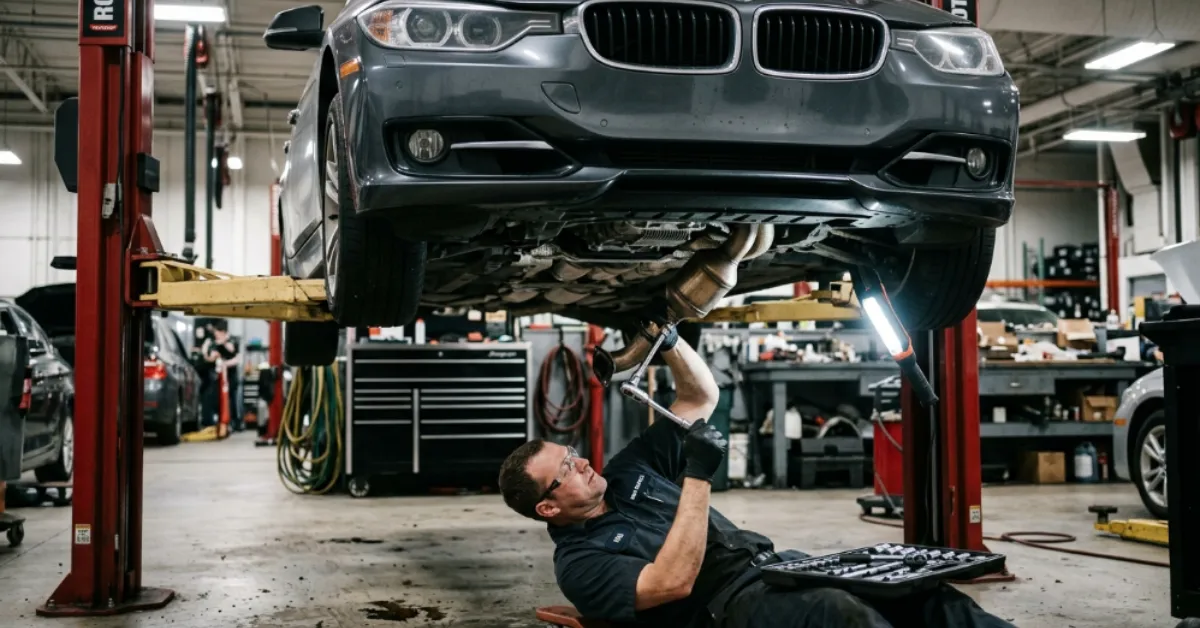
Certified exhaust system technicians carry out the complete catalytic converter assessment and repair procedure, then issue a written service report at job completion.
25–40%
Below dealer pricing
12-Month
Warranty on parts & labour
10,000+
Vehicles serviced
Signs to watch for
When Does a BMW Require Professional Catalytic Converter Repair?
| Issue | Symptoms / Signs | Possible Cause | Recommended Solution |
|---|---|---|---|
| Check Engine Light Active | P0420 or P0430 catalyst efficiency codes stored in DME | Substrate degradation reduces TWC conversion efficiency below the threshold | Exhaust gas analysis, lambda sensor test, substrate inspection, and converter replacement if required |
| Sulphur or Rotten Egg Odour | Strong hydrogen sulphide smell from the exhaust at warm idle | Substrate contamination from sulphur-rich fuel or rich running conditions | Fuel trim analysis, catalyst cleaning or replacement, and lambda sensor verification |
| Reduced Engine Power | Noticeable power loss above 3,000 RPM with normal fuel trim | Substrate blockage causing back-pressure above 1.5 bar | Back-pressure test, substrate inspection, and converter replacement |
| Rattling Noise From Underside | Metallic rattling from the exhaust system under acceleration | Fractured internal substrate loose inside the converter shell | Physical inspection, converter removal, and replacement with an OEM-compatible unit |
| Failed UAE Emissions Inspection | HC, CO, or NOx readings exceeding UAE RTA inspection limits | Degraded catalyst conversion efficiency or failed lambda sensor | Exhaust gas analysis, sensor testing, converter assessment, and ECU adaptation reset |
| Rough Idle With Rich Exhaust Smell | Unstable idle with strong fuel odour from the tailpipe | Failed downstream lambda sensor masking catalyst efficiency loss | Lambda sensor replacement, exhaust gas analysis, and fuel trim adaptation reset |
| DPF Warning Light Active | DPF full warning on BMW diesel models with reduced power mode | DOC degradation prevents sufficient exhaust temperature for DPF regeneration | DOC efficiency test, forced DPF regeneration, and DOC replacement if required |
| AdBlue Warning With NOx Fault | SCR efficiency fault codes with AdBlue consumption abnormality | Blocked AdBlue injector or degraded SCR catalyst substrate | AdBlue injector flow test, NOx sensor check, and SCR catalyst assessment |
Why it matters
Benefits of Professional BMW Catalytic Converter Repair
| Benefit | Description | Impact |
|---|---|---|
| Restored Emissions Compliance | Repair or replacement returns TWC conversion efficiency above 95%, reducing HC, CO, and NOx output to within UAE RTA inspection limits | Ensures the vehicle passes mandatory emissions testing without re-inspection delays |
| Correct Lambda Control | A serviceable converter allows the oxygen sensors to maintain closed-loop lambda control at a 14.7:1 air-fuel ratio within ±0.1 lambda | Stable lambda control improves fuel economy by 5 to 8% on engines running with degraded catalysts |
| Eliminated Back-Pressure | Replacing a blocked substrate restores exhaust flow, reducing back-pressure to below 0.5 bar at idle | Correct back-pressure recovers up to 8% of engine output on turbocharged BMW models |
| Protected DPF Service Life | Restoring DOC efficiency on diesel models maintains exhaust temperatures sufficient for active DPF regeneration | Preventing DPF over-accumulation above 45 g avoids unplanned DPF replacement, costing 3 to 5 times more than DOC repair |
| Reduced Fuel Consumption | Clean catalyst substrates allow the DME to maintain accurate fuel trim without prolonged over-fuelling correction cycles | Correct fuelling reduces fuel consumption by eliminating extended injection durations |
| Extended Oxygen Sensor Life | A serviceable catalyst substrate reduces the thermal and chemical load on downstream lambda sensors | Correct operating conditions extend downstream sensor service life beyond the typical 80,000 km replacement interval |
| Stable Idle and Smooth Acceleration | Correct exhaust flow and accurate lambda feedback remove hesitation and rough idle associated with degraded catalyst efficiency | Stable combustion feedback eliminates flat spots between 1,500 and 3,500 RPM |
Aftercare
Maintenance Guidance After BMW Catalytic Converter Repair
- Complete One Full Drive Cycle Before Evaluating Results: Allow the DME to complete a full closed-loop readiness cycle covering cold start, warm-up, cruise, and deceleration.
- Check OBD-II Readiness Monitors After 500 km: Confirm the catalyst monitor, oxygen sensor monitor, and fuel system monitor status flags have changed from incomplete to ready.
- Use the Fuel Grade Specified for Your BMW Engine: Using lower-grade fuel causes detonation, depositing unburned HC onto the catalyst substrate.
- Resolve Any Active Misfire Codes Before Driving: A single misfiring cylinder delivers unburned fuel to the catalyst, raising substrate temperature above 1,000°C within seconds.
- Inspect Exhaust Manifold Gaskets at Every 40,000 km Service: Manifold leaks introduce unmetered oxygen upstream of the catalyst, distorting fuel trim.
- Schedule Catalyst Condition Assessment Every 60,000 km: Periodic efficiency assessment identifies early-stage substrate degradation before conversion efficiency falls below threshold.
- Keep AdBlue Topped Above the 3-Litre Minimum on Diesel Models: Running the tank below 3 litres interrupts SCR dosing, allowing NOx output to rise above legal limits.
Verified reviews
What Our Customers Say
Real reviews from BMW owners in Abu Dhabi who have had bmw catalytic converter repair in abu dhabi completed at Exotic Auto Services.
Fleet coverage
BMW Models We Service in Abu Dhabi
Questions, answered
Frequently Asked Questions
A standard service covers OBD-II scanning, back-pressure measurement, exhaust gas analysis for HC, CO, CO₂, O₂, and NOx, substrate condition inspection, lambda sensor testing, chemical cleaning where applicable, and an ECU adaptation reset.
Chemical cleaning is appropriate when post-flush analysis confirms efficiency above 95% with no physical damage. Full replacement is required when substrate cell blockage exceeds 20% or melt zones are visible.
A single converter inspection and sensor replacement takes 2 to 3 hours. A dual-bank replacement takes 4 to 5 hours. A complete exhaust emissions service takes one full working day.
Converters with sulphur fouling or moderate carbon contamination without physical damage may recover through pressurised chemical cleaning. Fractured substrates require replacement.
Yes. DOC efficiency, DPF soot load, SCR system, and AdBlue dosing injector flow rate are all assessed on models fitted with these systems.
Engine misfires, oil consumption fouling the substrate, coolant ingress, sustained use of high-sulphur fuel, and physical impact damage all contribute to premature degradation.
A catalyst condition assessment every 60,000 km allows early-stage degradation to be identified before OBD-II monitors register a fault code.
Yes. All fuel trim adaptation values are cleared after replacement or cleaning, and OBD-II catalyst and oxygen sensor readiness monitors are confirmed complete.
Visit the workshop
Book Your BMW Service Today
Walk-in appointments and same-day service are available at the dedicated BMW specialist facility in Musaffah, Abu Dhabi.
- Hours
- Mon–Sat: 9:00 AM–10:00 PM · Sun: 9:00 AM–7:00 PM